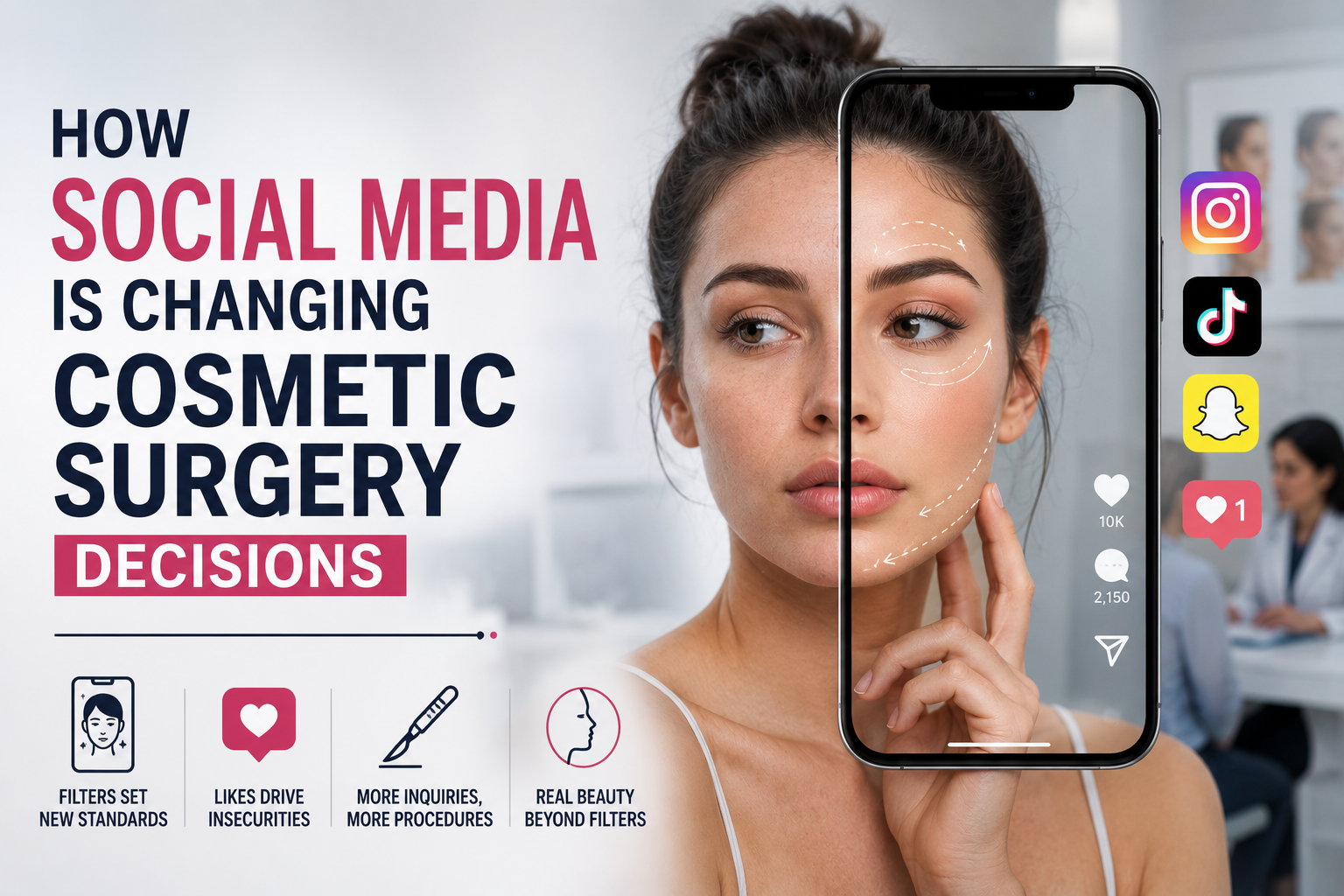
Social media has become an integral part of our lives. Apps such as Instagram and TikTok not only allow us to connect with our friends; they are also fundamentally changing our understanding of beauty and aesthetics. One of the biggest impacts of social media is beauty filters. The first filters released by Instagram smoothed the skin, enlarged the eyes and slightly slimmed the jawline. After a while, people began looking at their filtered photos and saying, “I wish my real face looked like this.” Used everywhere from Snapchat to TikTok, these filters are fuelling the aesthetic concerns of both young people and adults.
Almost 80 per cent of girls aged 13 use various filters to enhance their online appearance. As the gap widens between the digital face we admire and the real face in the mirror, the question ‘Could I look like this in real life too?’ begins to weigh on our minds. It is at this point that a range of procedures—from lip fillers to Botox, and from slimming the nose to contouring the jawline—are sought after in the hope of turning this ‘filtered life’ into reality.
Its Impact on Young People and ‘Snapchat Dysmorphia’
Social media is having a profound effect on young people in particular. The pressure to get ‘likes’ on phone screens has become far more significant than the pressure felt in the school canteen. The filtered faces popular on Snapchat and TikTok are driving an increase in young people’s demand for cosmetic surgery. A new term has even emerged: “Snapchat dysmorphia”. In this context, young people are seeking surgery to achieve the ideal appearance seen in their filtered selfies.
According to the American Society of Aesthetic Plastic Surgery (ASPS), over 229,000 cosmetic procedures were performed on young people aged 13–19 last year. Experts do not recommend cosmetic surgery for children who are not of an appropriate age or who are not psychologically ready. Consequently, the decision to undergo surgery takes into account not only ‘appearance’ but also development and mental health.
Surgeons’ Journey Through Social Media
Surgeon influencers have also emerged on social media platforms. From Florida to Miami, renowned cosmetic surgeons are sharing their stories, procedures and results. Names such as “Dr Miami” have amassed millions of followers on Instagram and TikTok. It has now become commonplace to have photos taken before procedures and share them with followers afterwards. As a result, the taboo surrounding plastic surgery has largely been lifted: whereas people used to deny having had cosmetic work done, many now turn their “I’ve had it done” confession into a public announcement.
The upside of this situation is that patients are now better informed about the different types of surgery. They now understand what a facelift or eyelid surgery entails and are familiar with the terms the doctor uses. However, there is also a downside: some patients may develop unrealistic expectations after looking at filtered, misleading photos on social media.
Boston-based facial surgeon Dr Keith Ladner sums up the issue as follows: “It may be the result everyone dreams of, but that doesn’t mean it will suit every patient. Results must always be tailored to the individual.” In short, an aesthetic result that one person loves may not be right for another. That is why a good surgeon focuses not on the ‘perfect aesthetic’ stories circulating on social media, but on the patient’s own face and needs.
The Pandemic and the Zoom Effect
The years spent in lockdown during the pandemic also brought a different perspective to this trend. Constantly seeing our faces on Zoom and video-calling apps led us to view our own appearance more critically. When I noticed my own tired, sad or one-sided facial features in the light, the question “What could I change about my nose, chin or cheeks?” came to mind. In other words, it wasn’t just filters; the new perspectives brought about by technology also increased aesthetic demands.
Technological Perspectives and Standards of Beauty
Social media and digital filters have created an algorithmic beauty standard. US journalist Elise Hu calls this the ‘technological gaze’. Our phone screens are, in effect, reprogramming us according to ideal beauty templates. For example, in an interview filmed in California, a speaker explained that TikTok’s face filters automatically brighten the skin, whiten the teeth and shape the eyebrows. These filters make features such as high cheekbones, defined eyebrows and full lips appear extraordinary. Consequently, many young people and adults find themselves looking in the mirror and thinking, ‘Why don’t I look like I do in the filter?’
This digital transformation is also evident in South Korea’s aesthetic trends. Seoul is known as the ‘aesthetic capital of the world’; almost one in two Korean women in their twenties has undergone some form of cosmetic procedure. Procedures such as having ‘traptoxs’ injected into the neck muscles, having slimming Botox injections, or having the jawbone filed down have become commonplace. It is even said that one clinic displays a jar in its lobby showcase containing shaved-down jawbones! This is an extreme example of how improving one’s appearance is now viewed as a “personal responsibility” and a “job guarantee”.
There is a similar trend in Turkey: according to the popular cosmetic surgeon Cemil Işık, “beauty trends on social media, influencers, and cosmetic procedures undertaken by celebrities are driving increased demand for cosmetic surgery.” In other words, everyone can now look to the cosmetic results achieved by film stars and social media influencers as a model.
Result
In short, social media has fundamentally transformed our decisions regarding cosmetic surgery. Our aesthetic desires are now shaped by a filtered photo just a click away. In this new digital world, healthcare professionals, alongside young patients, remind us of our true selves—even after we’ve been filtered. Filters and eye-catching Instagram posts may not disappear, but true beauty lies in the courage to love ourselves as we see ourselves in the mirror. Without getting lost in the whirlwind of social media, approaching our own reflection with scepticism and being able to say, “I am beautiful enough too”—that is what truly needs to change. With the hope of a world where beauty is no longer defined solely by facial features, but where diversity is embraced.
How Social Media Is Changing Cosmetic Surgery Decisions